Saudi Aramco’s $100 Billion Signal About the Future Value of Oil
The economics behind Saudi Aramco’s Jafurah expansion have important implications about their remaining spare capacity and outlook for future oil prices.

Saudi Aramco recently brought the first phase of its Jafurah gas development online, a $100 billion project that is expected to reach 2 billion cubic feet per day of sustainable production by 2030. The gas will be used for domestic power generation, allowing Saudi Arabia to displace roughly 500,000 barrels per day of crude that it currently burns for electricity. That crude will then be “freed up” for export, increasing the number of barrels available to global markets.
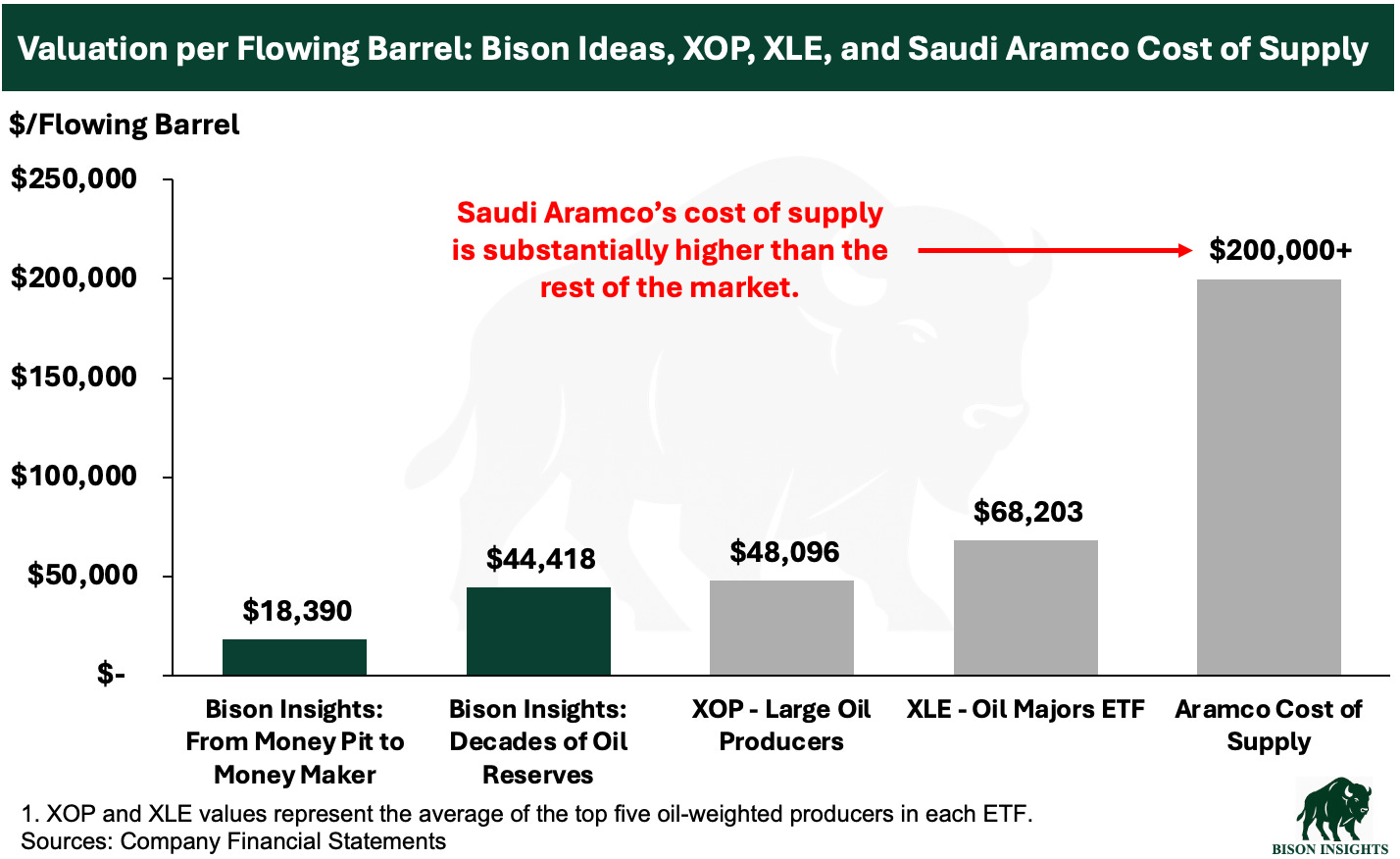
At first glance, this appears bearish for oil prices. More exportable supply should put downward pressure on prices. But looking past the physical barrels and considering the implications of the economics behind the project suggests the opposite conclusion: Saudi Aramco is effectively spending $100 billion to create an additional 500,000 barrels per day of oil production, implying a cost of ~$200,000 per flowing barrel.
Relative to North American oil producers, and especially the two oil-weighted companies I’ve written about in previous articles, the implied valuation embedded in Saudi Aramco’s decision is extraordinary: